Choosing a Hospitality Furniture Supplier in 2026 requires more than comparing catalog prices. Hotels now balance guest comfort, design identity, durability, sustainability, and delivery risk.
UN Tourism reported approximately 1.4 billion international tourist arrivals in 2024, reaching 99% of 2019 levels. JLL’s 2025 Global Hotel Investment Outlook also forecast a 15% rise in global hotel investment volume. More rooms mean more beds, chairs, casegoods, and replacement cycles. Yet demand alone does not guarantee quality.
Small details matter. A lobby chair should support long conversations without sagging. A bedside table should hide charging cables neatly. Finishes must survive luggage impacts, cleaning chemicals, humidity, and constant handling. The right Hospitality Furniture Supplier should provide material samples, test records, factory audits, warranty terms, and realistic lead times.
Danny Meyer, a respected hospitality operator, wrote in Setting the Table, “Hospitality is almost impossible to teach. Either you have it or you don’t.” His point applies to furniture selection. A supplier must understand how guests move, wait, rest, and return. Product knowledge is not enough.
Industry reports guide decisions, but they cannot replace physical testing. Some attractive pieces fail quickly. I have seen elegant veneers lose their edge in busy corridors. That is an uncomfortable lesson.
This guide will examine supplier experience, production controls, customization, environmental claims, compliance documents, and after-sales support. It will also question impressive promises. Because the cheapest quotation can become the most expensive choice.
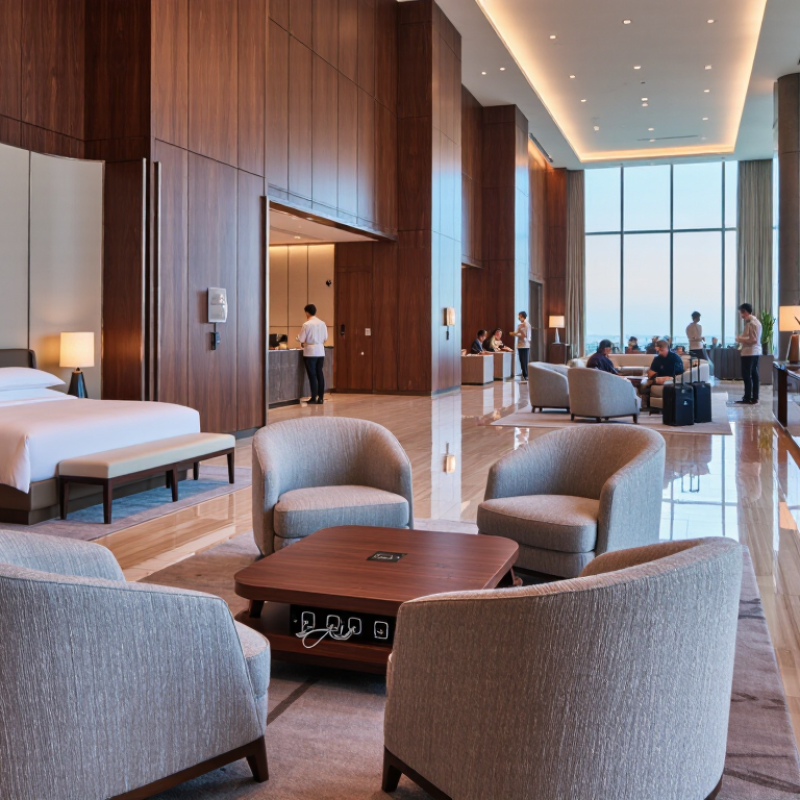
Set your 2026 furniture plan against actual hotel demand, not attractive showroom displays. STR’s 2024 U.S. hotel performance report recorded 63.0% occupancy, a $160.54 ADR, and $101.12 RevPAR. These figures show the revenue environment behind purchasing decisions.
A property with strong RevPAR can justify durable casegoods, faster replacement cycles, and upgraded guestroom seating. A lower-RevPAR hotel may need modular furniture, simpler finishes, and controlled installation costs.
Use occupancy to estimate room usage and wear. Use ADR to judge the design level guests may accept. RevPAR connects both measures with real revenue performance. CBRE’s 2025 U.S. Hotel Horizons report also expects moderate growth, rather than unlimited pricing power.
That matters. Suppliers should explain lifecycle value, not only initial cost. Ask for commercial-grade specifications, cleaning resistance, warranty terms, lead times, and replacement-part availability. Request samples under actual hotel lighting.
Make a room-by-room demand sheet. Record stayover frequency, luggage contact points, housekeeping pressure, and maintenance complaints.
High-occupancy rooms may need reinforced drawer runners and stain-resistant upholstery. Business-focused properties may need larger work surfaces and better charging access.
Our first forecast is often wrong. That is useful. Review monthly occupancy, ADR, and RevPAR changes before releasing every purchasing phase.
A supplier who adjusts quantities and delivery timing with your data is more valuable than one offering the lowest quotation. Metrics should guide the furniture, but guest comfort still deserves a human check.
How to Choose a Top Hospitality Furniture Supplier in 2026?
A hospitality supplier must survive more than a showroom inspection. Hotel chairs endure repeated impacts, spills, dragging, and daily cleaning. AHLA’s 2024 State of the Hotel Industry report states that U.S. hotels supported 8.3 million jobs in 2023. Heavy guest traffic makes furniture reliability a financial issue, not a visual preference. Ask suppliers for recent test reports, sample records, and material specifications. A polished PDF can still hide weak construction.
Screen each product against the correct BIFMA, ASTM, or EN requirement. BIFMA standards commonly address commercial seating, desks, and structural performance. ASTM specifications may cover load capacity, finish resistance, or upholstered furniture performance. EN 16139 and EN 15373 are relevant references for non-domestic seating strength and durability. Do not accept “tested to standards” without the exact standard number, edition, laboratory, and test result. I have seen suppliers confuse compliance with certification. That mistake is costly.
Tips: Place a sample chair in a busy corridor for two weeks. Record wobble, fabric wear, loose screws, and cleaning marks. Request cyclic-load results, not only static-load figures. Check whether testing used the final materials and hardware. Compare warranty exclusions carefully. A cheaper frame may become expensive after one damaged season. Leave room for doubt; real hotel conditions are rarely as clean as a laboratory.
A low purchase price rarely shows the full cost of hotel furniture. Compare each supplier against renovation benchmark data, not only the initial quotation. Useful benchmarks track replacement cycles, repair rates, installation hours, freight damage, and room downtime. A chair priced at $120 may need replacement after three years. A $190 chair may remain serviceable for seven years. The second option can reduce annual ownership costs.
Build a lifecycle cost sheet for every room category. Include purchase, shipping, customs, assembly, cleaning, repairs, storage, and disposal. Add revenue lost when rooms close for maintenance. For a 200-room hotel, one extra maintenance day per room can become a serious operational expense. Ask suppliers for documented warranty terms, test reports, maintenance instructions, and references from comparable renovations. Request actual delivery records, not polished promises.
Numbers still need judgment. My own early estimates have underestimated hardware failures and replacement labor. That mistake matters. Inspect drawer runners, edge sealing, upholstery seams, and metal joints before approval. Request a sample room and test furniture under daily housekeeping conditions. Compare the supplier’s projected lifespan with regional renovation benchmarks and your property’s usage pattern. A credible supplier explains weak points openly and updates the calculation when assumptions change. That transparency is often more valuable than a small discount.
Sustainability claims should begin with documents, not showroom language. The UN Environment Programme reports that buildings create about 37% of global energy-related emissions. Furniture choices therefore deserve closer scrutiny, even when they appear small.
Ask suppliers for valid FSC certificates, certificate numbers, and chain-of-custody scopes. FSC’s 2023 facts report records more than 160 million hectares under certified forest management worldwide. That figure shows scale, but it does not prove every table uses certified wood. Check the exact product, material, and certificate validity. Small details matter.
Request product-specific EPDs, not general environmental brochures. An EPD should identify its product category rules, declared unit, impact results, and independent verification. EPD International reported more than 20,000 published environmental declarations in recent years, yet quality still depends on correct product matching. A similar-looking chair may have a different frame, foam density, or shipping profile. Do not assume.
LEED documentation adds another useful checkpoint. The LEED v4.1 materials credits recognize verified environmental declarations and responsible raw-material sourcing, including FSC evidence. Ask the supplier to provide formatted letters, invoices, and supporting certificates before purchase. In practice, missing paperwork can delay a project more than production. That is easy to underestimate. A polished PDF is not enough. Procurement teams should recheck expiration dates, because even reliable suppliers can leave outdated files online.
How to Choose a Top Hospitality Furniture Supplier in 2026?
International tourism reached 1.4 billion arrivals in 2024, recovering 99% of 2019 levels, according to UN Tourism’s January 2025 World Tourism Barometer. Hotel renovation demand is returning quickly. Your supplier’s service-level agreement should therefore measure delivery, not merely promise it. Set an on-time-in-full target above 95%, with separate deadlines for samples, production, shipping, and installation. Ask for the last twelve months of performance data. A polished presentation is not evidence.
Capacity needs practical testing. Request monthly production capacity, current factory loading, backup material sources, and a written escalation path. RICS’ 2024 Global Construction Monitor continued to identify supply-chain disruption and cost pressure as major project concerns. Link payments to inspection milestones, packaging accuracy, and damage rates. For imported furniture, track customs-document accuracy and port dwell time. A supplier claiming unlimited capacity deserves careful questioning.
Support should have measurable response times. Require replies within four business hours for critical defects, corrective action within two working days, and replacement plans within five days. Track first-response time, resolution time, warranty closure, and recurring fault rates. I would also score communication quality after a difficult delivery, not only during sales meetings. Some delays will happen. Hidden delays are worse. A perfect scorecard is unrealistic, and my own early vendor comparisons often underweighted installation support. That mistake can turn a finished shipment into an unfinished hotel room.
Rank Delivery, Capacity and Support Using SLA Performance Metrics
The chart compares anonymized supplier profiles using four practical SLA indicators: on-time delivery, order capacity fulfillment, first-response speed, and defect-free delivery. Higher scores indicate stronger operational reliability, while a lower response-time value represents faster support.
Request recent test reports, material specifications, sample records, and laboratory details. A polished PDF proves little.
Screen products against recognized commercial seating, structural, load, finish, and upholstery durability requirements. Ask for the exact standard number and edition.
Place it in a busy corridor for two weeks. Record wobbling, fabric wear, loose screws, and cleaning marks.
No. Request cyclic-load results because hotel chairs face repeated impacts, dragging, and daily use.
Testing should use the approved frame, fabric, hardware, and finish. A substitute sample may hide weak construction.
Include purchase, freight, customs, assembly, cleaning, repairs, storage, disposal, and room downtime. Small omissions can distort the result.
Compare expected service years, repair rates, replacement labor, and downtime. A higher price may reduce annual ownership costs.
Check drawer runners, edge sealing, upholstery seams, metal joints, and screw connections. I once underestimated hardware failures.
Read exclusions carefully and request documented claims procedures. Do not rely on attractive promises.
The supplier explains weak points, shares delivery records, and changes assumptions when evidence changes. Transparency matters.
Choosing the right Hospitality Furniture Supplier in 2026 requires more than comparing product prices or showroom designs. Hotels should first define their furniture needs using local STR occupancy, ADR, and RevPAR data, then evaluate suppliers against recognized durability standards such as BIFMA, ASTM, and EN. These benchmarks help confirm that furniture can withstand daily guest use while maintaining safety, comfort, and appearance.
A thorough selection process should also compare lifecycle costs, including maintenance, replacement, installation, and renovation expenses, against current hotel improvement benchmarks. Sustainability claims should be verified through credible documentation such as FSC certifications, Environmental Product Declarations, and LEED-related product information. Finally, hotels should assess delivery reliability, production capacity, after-sales support, and service-level agreement performance. By ranking suppliers across quality, total value, environmental responsibility, and operational dependability, hospitality businesses can build a furniture strategy that supports guest satisfaction and long-term investment goals.